
Introduction: The Urban Boom and the Demand for Interlocking Pavers
Pakistan’s urban centers and industrial zones are experiencing an unprecedented wave of infrastructure modernization. Across major public sector infrastructure, master-planned housing societies, commercial fueling stations, and massive logistics hubs, traditional asphalt and plain concrete pavements are rapidly being replaced by high-strength interlocking pavers, popularly known as tuff tiles.
Driven by their exceptional durability under heavy wheel loads, ease of localized repair, and resistance to monsoon rainwater damage, tuff tiles have become the standard for modern pavement engineering. For civil engineering firms, commercial contractors, and industrial investors, setting up an integrated tuff tile plant represents a highly secure, high-yield manufacturing business.
However, entering this market requires an understanding of how machinery configuration dictates product quality. To secure institutional contracts from corporate entities or government authorities, your plant must consistently achieve compressive strengths between $4,000 text{ PSI}$ and $7,000+ text{ PSI}$.
This exhaustive technical guide delivers an in-depth breakdown of current market rates for a tuff tile machine, evaluates distinct automation tiers, details raw material mix designs, and establishes an operational setup blueprint designed for long-term commercial success.
2. Deciphering the Core Problem: The Pitfalls of Substandard Paver Production
The interlocking paver market is highly competitive, and product quality is determined by structural performance and surface finish. Many new investors make the mistake of choosing cheap, under-engineered machinery, which often leads to severe operational and financial setbacks:
Honeycombing and Surface Crumbling
Unlike standard concrete wall blocks, tuff tiles are exposed to intense friction and abrasive wear from moving vehicles. A tuff tile maker machine that lacks sufficient hydraulic compression force and targeted table vibration will produce tiles with tiny internal air pockets. When the winter freezing or monsoon rainfall cycles hit, these poorly compacted tiles absorb water, leading to rapid surface crumbling and premature pavement failure.
Bleeding and Pigment Fading
Premium interlocking pavers require a distinct, double-layer design—a thick, high-strength concrete base layer and a vibrant, smooth top color layer. Low-end machines struggle to compress these two layers together uniformly. This poor cohesion causes the colored face mix to peel or flake off under heavy truck traffic.
Pallet and Component Warping
Poorly designed machines with lightweight frames flex slightly under high hydraulic cycles. This microscopic movement causes uneven thickness across a single production batch, leading to uneven surfaces when the tiles are laid in interlocking grid patterns on-site.
3. Technology Breakdown: Navigating Tuff Tile Machine Configurations
The level of automation in your plant directly determines your daily output capacity, color blending capabilities, and overall labor expenses.
+--------------------------------------------------------------------------+
|                      TUFF TILE PRODUCTION ARCHITECTURE                   |
+--------------------------------------------------------------------------+
|                                                                          |
|  [BASE LEVEL: MANUAL] --------> [MID LEVEL: SEMI-AUTO] ------> [AUTOMATIC]
|  - Wet Casting Molds          - Central Hydraulic Pack  - PLC Controlled
|  - Manual Demolding Tables    - Conveyor Feed Lines     - Dual-Hopper Line
|  - High Labor, Low Output     - Scalable Production     - Mass Scale Output
|                                                                          |
+--------------------------------------------------------------------------+
1. Manual Wet-Cast Vibro-Table Systems
This traditional setup uses heavy-duty, flexible PVC or polyurethane plastic interlocking molds placed on a basic vibrating table. Workers fill the molds with wet concrete mix, vibrate them to remove air bubbles, and place them on storage racks to cure for 24 to 48 hours before manual stripping.
- Target Audience: Small-scale rural startups, local street-level contractors, and low-budget investments.
- Limitations: High labor costs and a slow production cycle make it difficult to fulfill large commercial volume orders quickly.
2. Semi-Automatic Hydraulic Paver Block Machines
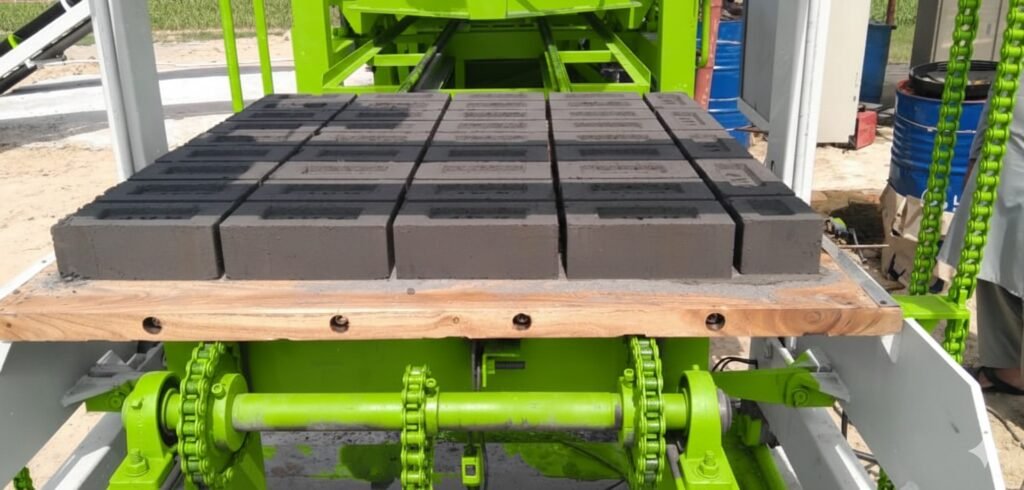
A major technological step up, these plants utilize direct hydraulic compression combined with high-frequency table vibration to mold semi-dry concrete mixes. The molded tiles are pushed out onto wooden or plastic pallets, completely eliminating the need for individual plastic molds.
- Target Audience: Established regional building material suppliers and dedicated commercial block factories.
- Key Advantage: It features automated belt conveyor feeding and simple lever-controlled hydraulic valves, ensuring a highly consistent cycle time.
3. Fully Automatic Multi-Hopper Tuff Tile Production Lines
These advanced systems are managed by a central PLC system with automated aggregate batching and moisture sensors. They are equipped with a specialized dual-hopper system: the first hopper dispenses the coarse concrete base mix, while the second precisely layers the vibrant, fine-sand color face mix just seconds before final high-tonnage hydraulic pressing.
- Target Audience: Large-scale commercial infrastructure suppliers and CPEC infrastructure contractors.
- Key Advantage: It delivers maximum output capacity, exceptional dimensional accuracy, and optimized cement consumption per tile.
4. Current Market Analysis: Tuff Tile Machine Price in Pakistan (2026 Matrix)
Machinery pricing varies based on total structural steel mass, the rated hydraulic compression tonnage (measured in megapascals or total tons), and the inclusion of dual-hopper systems for face-mix coloring.
The comprehensive matrix below details the estimated capital layouts for certified interlocking paver and tuff tile plants across Pakistan:
Comprehensive Machinery and Plant Pricing Matrix
| Equipment Class & Configuration | Automation Level | Daily Production Output (8-Hour Shift) | Primary Hydraulic Compaction Force | Estimated Price Range (PKR) |
| Vibro-Table Setup (With 500 PVC Molds) | Manual System | $800 – 1,200 text{ Paving Units}$ | N/A (Mechanical Vibro Only) | PKR 450,000 – 850,000 |
| Small Hydraulic Entry Stationary Line | Semi-Automatic | $2,500 – 3,500 text{ Paving Units}$ | $60 – 80 text{ Tons}$ | PKR 2,200,000 – 3,500,000 |
| Standard Commercial Paver Plant | Semi-Automatic | $4,500 – 6,000 text{ Paving Units}$ | $100 – 120 text{ Tons}$ | PKR 3,800,000 – 5,500,000 |
| Premium Dual-Hopper Machine Line | Fully Automatic (PLC) | $8,000 – 12,000 text{ Paving Units}$ | $150 – 200 text{ Tons}$ | PKR 6,500,000 – 9,500,000 |
| Advanced Heavy Industrial Plant Hub | Fully Automatic (PLC) | $15,000 – 25,000+ text{ Units}$ | $250 – 350+ text{ Tons}$ | PKR 12,500,000 – 22,000,000+ |
💡 Expert Tip: Exploring the Secondary/Used Machinery Market
When searching for a used tuff tile machine price in pakistan or browsing verified listings for a tuff tile machine price in pakistan olx, you can often find decent entry-level semi-automatic systems for PKR 2,800,000 to PKR 4,000,000. However, to avoid costly repairs down the line, always make sure a professional technician verifies these core components:
- Hydraulic Valve Block Inspection: Check for micro-pitting or leaks across the main spool valves.
- Vibration Table Dynamic Balance: Ensure the dual eccentric shaft assemblies spin in perfect synchronization.
- PLC Controller Compatibility: Verify that the control program isn’t locked by a non-local password, allowing you to make future timing modifications.
5. Technical Insights: Engineering Concrete Paver Mix Designs
Achieving a highly durable tile that passes strict structural testing requires a precise raw material mix design. Tuff tiles produced on high-pressure hydraulic machines use a low-moisture, semi-dry concrete mix (often called zero-slump concrete).
          +-------------------------------------------------------+
          |             DYNAMIC DOUBLE-LAYER COMPOSITION          |
          +-------------------------------------------------------+
                                      |
            +-------------------------+-------------------------+
            |                                                   |
            v                                                   v
  [COLOR FACE MIX LAYER: 5-8mm]                       [BASE STRUCTURAL LAYER: 50-70mm]
  - Fine Silica Sand & Quartz Dust                    - Crushed Limestone Bypass Screenings
  - Premium Inorganic Iron Oxide Pigments             - Fine Chenab Sand Coarse Matrix
  - High Cement Ratio for Dense Wear Surface          - Optimized OPC Binder Foundation
1. The Core Structural Base Layer
This layer makes up the bulk of the tile’s thickness (typically $50text{mm}$ for light footpaths or $70text{mm}$ to $80text{mm}$ for heavy-duty industrial loading bays).
- Material Matrix: A precise blend of coarse crushed limestone bypass screen ($3text{mm}$ to $6text{mm}$ sizing from Sargodha or Nooriabad), clean Chenab sand, and Grade 42.5 Ordinary Portland Cement.
- Proportion Targeting: Aim for an effective ratio of $1 : 1.5 : 3$. Keep the water-cement ratio incredibly tight—between $0.32$ and $0.35$—to ensure the mix stays cohesive during high-pressure molding.
2. The Color Face Mix Layer
This thin top layer (typically $5text{mm}$ to $8text{mm}$ thick) acts as the tile’s protective, weather-resistant outer shell.
- Material Matrix: Formulated using very fine washed silica sand, white cement (or standard OPC depending on color target intensity), and premium inorganic iron oxide pigments (imported brands like Lanxess Bayferrox are highly recommended to prevent UV fading over the years).
- Proportion Targeting: Mix at a rich $1 : 2$ ratio of cement to fine sand to guarantee a dense, smooth, and highly water-resistant surface finish.
6. Real-World Use Case: Establishing a Production Plant in Lahore’s Saggian Area
To see how this works in practice, let’s look at an industrial investor who set up a mid-scale automated paver production facility in the Saggian Bypass area of Lahore, targeting the region’s expanding private residential housing developments.
The Plant Infrastructure
The investor deployed a commercial semi-automatic hydraulic machine equipped with an extended chain conveyor line, a twin-shaft compulsory concrete mixer, and a localized dual-hopper system for applying a colored face mix.
+-----------------------------------------------------------------------+
|                       TUFF TILE PLANT RUN MATERIAL FLOW               |
+-----------------------------------------------------------------------+
|                                                                       |
| [Twin-Shaft Mixer] -> [Base Conveyor Belt] ---> [Main Matrix Hopper]  |
|                                                                     | |
|                                                                     v v
| [Face Mix Pan Unit] -> [Color Feed Belt] -------> [Color Face Hopper] |
|                                                                     | |
|                                                                     v v
| [Finished Pallets Out] <--- [High Pressure Press] <-----------------+ |
+-----------------------------------------------------------------------+
Sourcing Materials
To optimize costs, the facility sources its crushed aggregate screens directly from Sargodha and blends them with fine sand from the Ravi river basin.
Operational Performance
Operating a single 8-hour shift with a crew of 6 workers, the plant produces roughly 5,000 high-density interlocking zigzag pavers daily. These tiles achieve an impressive average compressive strength exceeding $5,500 text{ PSI}$ after standard curing.
By securing steady supply agreements with local housing society developers, the factory generated enough consistent volume to completely recover its initial machinery setup capital within just 8 months of starting operations.
7. Commercial Architecture: Interlocking Paver Unit Economics
To help you assess the commercial feasibility of this sector, here is a detailed production cost breakdown for a single square foot of standard $60text{mm}$ interlocking tuff tiles based on current material pricing:
Unit Cost Analysis Matrix (Per Square Foot Basis)
| Operational Input Variable Component | Material Metrics / Sourcing Proportions | Net Cost Component (PKR) |
| Ordinary Portland Cement Content | Premium OPC Base Layer + Top Face Layer | PKR 18.50 |
| Crushed Aggregates & Silica Sand | Sargodha Screenings + Fine Silica Blend | PKR 11.00 |
| Iron Oxide Pigment Additives | UV-Stabilized Imported Pigment Dose | PKR 4.50 |
| Direct Production Plant Labor | Distributed Across Shift Output Total | PKR 3.00 |
| Electrical Power & Machinery Fuel | Hydraulic Pack Motors + Forklift Fuel | PKR 2.00 |
| Pallet & Mold Wear Allowance | Scheduled Maintenance & Depreciation | PKR 1.00 |
| Total Net Production Cost | Ex-Factory Base Production Cost | PKR 40.00 / Sq. Ft. |
Profit Margin Realization
- Average Market Wholesale Value: PKR 75.00 – 85.00 per Sq. Ft.
- Net Profit Margin per Square Foot: PKR 35.00 – 45.00.
- Daily Profit Potential (At 5,000 Sq. Ft. Daily Output): $approx text{PKR } 175,000 – 225,000$.
This exceptional earning potential is why the paving manufacturing industry continues to attract significant interest from smart industrial investors. Many modern manufacturers such as Silver Steel Mills now integrate automated control systems to improve production efficiency, allowing new plants to achieve these high margins easily while maintaining strict product quality standards.
8. Common Pitfalls to Avoid When Purchasing a Tuff Tile Plant
Investing in a paver block production plant involves several common pitfalls that can impact your long-term returns:
1. Using Standard Pan Mixers for the Colored Face Layer
Standard mixers cannot blend fine pigments uniformly with sand and cement, which often leads to visible color streaks across your finished tiles. To achieve a perfectly consistent, vibrant color surface, always invest in a dedicated, high-speed planetary or intensive counter-current pan mixer for your top face-mix layer.
2. Overlooking Water-Cement Ratio Precision
Adding too much water to your mix design makes the semi-dry concrete sticky. This causes the wet tiles to deform or slump when the machine strips the mold away onto the production pallets. Investing in digital moisture probes for your main mixer ensures your concrete retains the exact consistency needed for clean demolding.
3. Neglecting Proper Pallet Quality
The wooden or plastic pallets that support your fresh tiles through the compression and curing stages must be completely flat. Using warped, cheap, or uneven pallets will crack or distort your fresh concrete tiles before they have a chance to properly cure.
9. Comprehensive Preventative Maintenance Protocols
To ensure your machinery maintains maximum uptime and a long service life, implement these strict operational schedules:
Daily High-Pressure Cleaning
At the end of every shift, use high-pressure water jets to thoroughly clean the mold core, tamper head, and feed drawer. Dried concrete buildup inside the mold cavity will score the steel plates, leading to deformed tiles and rapid mold wear.
Weekly Guide-Pillar Lubrication
The main hydraulic tamper head slides up and down along heavy steel guide pillars thousands of times a day. Clean these pillars weekly to remove abrasive concrete dust, and apply a high-quality, non-sticky lubricant to ensure smooth operation.
Monthly Hydraulic Oil Filtering
The intense pressure cycles of a paver machine place significant stress on your hydraulic fluid. Regularly check your oil temperature gauges to ensure they stay below $55^circtext{C}$, and replace your main hydraulic oil filter elements every month to protect your pump valves from microscopic dust contamination.
10. Future Trends: The Convergence of Paving and Modern Industrial Infrastructure
As Pakistan’s industrial manufacturing sector becomes more advanced, developers are taking a more comprehensive approach to facility design. High-volume tuff tile production is no longer viewed as an isolated business. Instead, it is increasingly integrated with larger structural developments, such as pre-engineered steel buildings in pakistan (PEB).
+--------------------------------------------------------------------------+
|                  MODERN INDUSTRIAL SITE DEVELOPMENT                      |
+--------------------------------------------------------------------------+
|                                                                          |
|  [Factory PEB Structural Line] ------> High-Clearance Warehouse Building |
|                                                    ^                     |
|                                                    | (Site Integration)  |
|                                                    v                     |
|  [Tuff Tile Plant Infrastructure] ---> High-Strength Heavy Duty Pavers   |
|                                        (For Loading Bays & Access Roads) |
+--------------------------------------------------------------------------+
Modern warehouse logistics complexes regularly combine heavy pre-engineered steel framing with expansive outdoor loading docks paved with high-strength concrete interlocking tiles. Setting up a versatile manufacturing facility that can supply both precision paving tiles for heavy truck traffic and structural materials for nearby warehouse perimeters positions your business perfectly to win major commercial construction contracts.
11. Strategic Action Plan for Industrial Investors
Investing in a modern hydraulic tuff tile plant is a proven way to secure long-term returns in Pakistan’s expanding infrastructure sector. However, long-term profitability requires shifting your focus from minimizing your upfront machinery costs to maximizing your plant’s overall operational efficiency and product consistency.
Start by conducting a thorough market assessment of the paving tile demand and raw aggregate sourcing options in your target area. Next, secure an operational site with access to a reliable three-phase power supply, and select an experienced machinery supplier that provides dependable local technical support and uses high-quality, wear-resistant steel molds. Focusing on strict quality control and a disciplined preventative maintenance schedule will help you build a highly profitable, sustainable paving manufacturing business.
FAQ Section
Q1: What is the estimated total capital required to set up a commercial semi-automatic tuff tile factory in Pakistan?
Setting up a complete, commercial-grade semi-automatic factory typically requires an investment of PKR 5,500,000 to PKR 8,500,000. This budget covers the main hydraulic press machine equipped with a dual-hopper assembly, a heavy-duty twin-shaft concrete mixer, raw material feed conveyors, a set of custom steel molds, and an initial inventory of production pallets.
Q2: Why is the dual-hopper system considered essential for premium tuff tile production?
A dual-hopper system allows you to produce cost-effective, premium-quality tiles. The first hopper fills the mold with a budget-friendly coarse aggregate mix for the tile’s thick structural base, while the second hopper layers a premium, highly concentrated pigment-and-sand mix onto the top surface. This allows you to achieve an excellent finish and long-lasting color without incurring the high cost of coloring the entire body of the tile.
Q3: What is the ideal thickness specification for concrete pavers used in heavy traffic zones?
For standard residential driveways, pedestrian walkways, and public footpaths, a tile thickness of $50text{mm}$ to $60text{mm}$ is ideal. For heavy-duty industrial environments—such as commercial logistics warehouses, truck loading docks, and fuel stations—always use a tile thickness of $80text{mm}$ to ensure the pavement can safely handle continuous heavy axle loads.
Q4: How long does it take for fresh hydraulic tuff tiles to fully cure before they can be delivered to a site?
Tiles produced via hydraulic compression can be moved off their production pallets onto curing stacks after 24 hours. Once stacked, they should be continuously water-cured for at least 7 to 10 days (or treated in an advanced steam curing chamber). For optimal performance and to prevent cracking, allow the tiles to reach their full design strength over a standard 28-day window before delivering them to heavy traffic project sites.
Q5: Can a standard tuff tile machine also be used to manufacture building blocks?
Yes. Modern hydraulic paver machines are highly versatile. By removing the paver mold and installing a different block mold assembly, you can easily repurpose the machine to manufacture standard 4″, 6″, or 8″ hollow structural blocks, solid bricks, or light highway kerbstones. This changeover can be completed by a skilled team in under an hour.