
Pakistan’s civil construction sector is undergoing a massive shift from traditional, low-tech, on-site volumetric mixing to highly precise, centralized weight-batching. Driven by demanding engineering specifications for multi-story residential towers, extensive commercial highways under regional development initiatives, and massive industrial warehouse projects, the demand for consistent concrete has never been higher.
For contractors, civil engineers, real estate developers, and industrial investors, purchasing an industrial-grade batching facility is no longer a luxury—it is an absolute necessity to stay competitive. Achieving high compressive strengths (such as $3,000 text{ PSI}$ to $6,000+ text{ PSI}$) consistently requires automated control over water-cement ratios, aggregate grading, and chemical admixtures.
This comprehensive guide offers an expert, practical look into the market for a concrete batching plant in pakistan. We break down the technical differences between stationary and mobile setups, evaluate pricing dynamics across various capacities, and provide a clear framework for building a profitable ready-mix concrete business.
2. Deciphering the Core Problem: The Financial and Operational Risks of Poor Batching
Investing in a concrete batching plant is a significant financial decision. Many buyers make the mistake of focusing solely on the lowest price, which often leads to major operational and financial hurdles down the line:
The Danger of Inaccurate Batching
A low-quality plant with inferior load cells can miscalculate aggregate and cement weights. In a typical $M25$ mix design ($1:1:2$ nominal approximation), a deviation of just $2%$ in water or cement content can drop the concrete’s actual compressive strength by over $15%$. If core cylinder tests fail at a commercial project site, structural engineers will reject the pour, leading to costly demolition, lawsuits, and damaged reputations.
Rapid Mechanical Wear from Abrasive Aggregates
The limestone aggregates sourced from regions like Margalla, Sargodha, or Sakhi Sarwar are highly abrasive. Batching plants built with standard mild steel liners in the mixing drum will wear out quickly, requiring extensive maintenance and costly downtime within their first year of operation.
Unreliable Automation and Electronics
Cheap, unbranded control panels frequently glitch when exposed to high ambient temperatures and dust. A single component failure in a non-standard PLC can completely halt production, stranding a fleet of transit mixers with wet concrete spinning in their drums.
3. Technology Breakdown: Twin-Shaft, Planetary, Mobile, and Stationary Plants
Choosing the right plant configuration means matching your technical requirements with the mobility needs of your specific construction project.
+--------------------------------------------------------------------------+
|                      CONCRETE BATCHING PLANT SEGMENTS                     |
+--------------------------------------------------------------------------+
|                                                                          |
|  [STATIONARY PLANTS] -------> [MOBILE / PORTABLE] -----> [COMPACT / MINI]|
|  - High Output (60-240 m³/h)  - Quick Tow Chassis        - Small Footprint|
|  - Twin-Shaft Intensive Mix   - Integrated Feed Belts    - Reversible Drum|
|  - Commercial Ready-Mix Hub   - Linear Infrastructure    - On-Site Utility|
|                                                                          |
+--------------------------------------------------------------------------+
Stationary Concrete Batching Plants
These plants are built for long-term, high-volume production at a dedicated site. They typically feature heavy structural steel foundations, large multi-compartment aggregate bins (often 3 to 4 bins of $20 text{ m}^3$ to $40 text{ m}^3$ each), and high-capacity cement silos ($50 text{ to } 200 text{ Tons}$).
- Mixing Technology: They almost exclusively use heavy-duty Twin-Shaft Mixers that deliver rapid, intensive mixing through counter-rotating shafts equipped with durable chromium-manganese alloy paddles.
- Target Audience: Commercial ready-mix concrete suppliers, massive dam projects, and permanent precast concrete product factories.
Mobile Concrete Batching Plants
Built on a heavy-duty, integrated wheeled chassis with a standard kingpin hitch, a mobile concrete batching plant can be folded up and towed by a standard prime mover. These systems integrate the aggregate bins, pan/twin-shaft mixer, water weighers, and control cabin onto a single frame.
- Target Audience: Highway contractors, canal lining operations, and remote infrastructure projects where the plant must move frequently as work progresses.
- Key Advantage: Minimal civil foundation work required, allowing for rapid deployment and setup within just 48 to 72 hours of arriving on site.
Compact / Mini Batching Plants
These systems are a great choice for smaller urban construction sites with limited space. They often feature a compact footprint and utilize space-saving Reversible Drum Mixers or planetary mixing systems.
- Target Audience: Mid-scale building contractors, urban plaza builders, and local bridge contractors who need a steady on-site supply of $10 text{ m}^3 text{ to } 30 text{ m}^3$ of concrete per hour without relying on outside ready-mix suppliers.
4. Market Analysis: Concrete Batching Plant Price in Pakistan (2026 Matrix)
The total cost of a batching plant depends heavily on its rated hourly output (measured in cubic meters per hour or $text{m}^3/text{h}$), the build quality of its mixing system, and the country of origin for its electronic and pneumatic components.
The comprehensive pricing matrix below details the estimated capital layout required across various machine classes and regional configurations:
Comprehensive Batching Plant Pricing and Capacity Matrix
| Plant Model Class & Configuration | Mixer Technology Style | Rated Production Capacity (m3/h) | Total Power Consumption (kW) | Estimated Price Range (PKR) |
| CBP-30 Mini/Compact | Reversible Drum / Pan | $25 – 30 text{ m}^3/text{h}$ | $45 – 55 text{ kW}$ | PKR 4,500,000 – 6,500,000 |
| CBP-45 Mobile Trailer Line | Planetary / Twin-Shaft | $40 – 45 text{ m}^3/text{h}$ | $65 – 75 text{ kW}$ | PKR 7,500,000 – 11,000,000 |
| CBP-60 Stationary Industrial | Heavy Twin-Shaft | $55 – 60 text{ m}^3/text{h}$ | $90 – 110 text{ kW}$ | PKR 13,000,000 – 18,000,000 |
| CBP-90 Premium Commercial | Advanced Twin-Shaft | $85 – 90 text{ m}^3/text{h}$ | $140 – 165 text{ kW}$ | PKR 22,000,000 – 32,000,000 |
| CBP-120 Mega Stationary | Heavy-Duty Twin-Shaft | $115 – 120 text{ m}^3/text{h}$ | $180 – 220 text{ kW}$ | PKR 38,000,000 – 55,000,000 |
| CBP-240 Twin-Mixer Hub | Dual Twin-Shaft Lines | $230 – 240 text{ m}^3/text{h}$ | $360 – 440 text{ kW}$ | PKR 75,000,000 – 120,000,000+ |
💡 Expert Tip: Hidden Ancillary Costs to Keep in Mind
When evaluating a concrete batching plant price in pakistan, remember that the base price rarely covers the entire operational setup. Buyers should also budget for these essential ancillary components:
- Bolted Cement Silos ($100text{-Ton}$ capacity with screw conveyors): PKR 1,500,000 – 2,500,000 per silo.
- Industrial Diesel Generator Set ($150text{ kVA to } 300text{ kVA}$ Prime): PKR 3,000,000 – 6,000,000.
- Deep-Well Water Storage System with Chiller Units: PKR 800,000 – 2,000,000 (critical for keeping concrete temperatures below $32^circtext{C}$ during hot summer pours).
5. Technical Insights: Engineering Metrics for Commercial Buyers
To get the best value from your investment, look past basic sales brochures and carefully evaluate these key technical specifications:
         +-------------------------------------------------------+
         |           AUTOMATED WEIGHT BATCHING SYSTEM            |
         +-------------------------------------------------------+
                                     |
              [Aggregate Bins] [Cement Silo] [Water/Admixture]
                                     |
              (S-Type Electronic Load Cells - RS485 Bus Connection)
                                     |
                                     v
                  [Centralized PLC Control Processor Panel]
                                     |
                (Proportional Pneumatic Cylinder Gate Controls)
                                     |
                                     v
                         [Twin-Shaft Mixing Drum]
1. The Dynamic Weighing System and Load Cells
The accuracy of your batching plant relies on its electronic load cells. Premium plants use highly accurate S-type tensile or shear-beam load cells securely linked to a centralized PLC via high-speed RS485 digital connections. The system should deliver a weighing accuracy within $pm1%$ for cement, water, and chemical admixtures, and within $pm2%$ for large raw aggregates.
2. Pneumatic Actuators and Air Compressor Systems
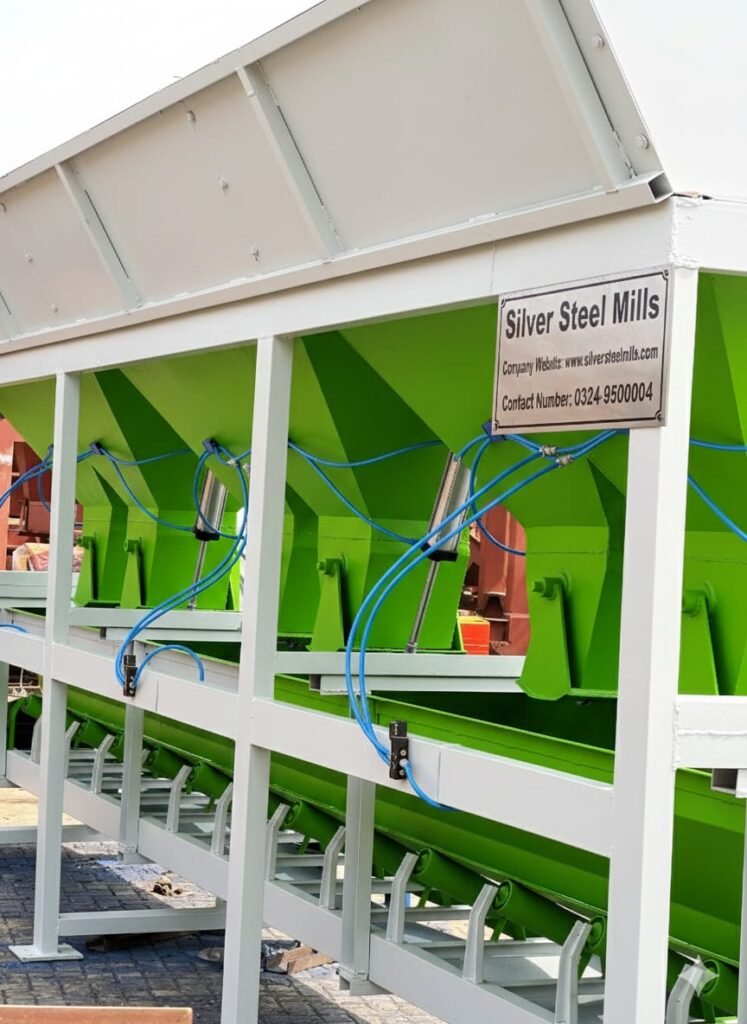
The discharge gates beneath the aggregate bins and weighing hoppers open and close thousands of times every day. Look for plants equipped with heavy-duty pneumatic cylinders paired with high-volume, reliable air compressors (such as those from Ingersoll Rand or Atlas Copco). These components must handle a constant operating pressure of $0.7 text{ to } 1.0 text{ MPa}$ without sticky valve movements or air pressure drops.
3. Mixing Drum Liners and Paddle Metallurgy
The inner walls of your mixing drum take a beating from constant aggregate abrasion. Make sure the batching plant features replaceable liner tiles and mixing paddles cast from Ni-Hard or High-Chromium White Iron Alloys, with a minimum hardness rating of $600 text{ BHN}$ (Brinell Hardness Number). Standard mild steel liners will wear thin quickly, leading to costly maintenance shutdowns.
6. Real-World Use Case: Launching a Commercial Ready-Mix Setup in Karachi
To understand how a batching plant operates commercially, let’s look at a concrete supply company based in the industrial zone of Landhi, Karachi.
The Challenge
The company won a contract to supply over $80,000 text{ m}^3$ of certified structural concrete for a major industrial development and warehouse project in nearby Port Qasim. They needed a system that could produce concrete continuously while keeping the mix temperature below $32^circtext{C}$ during hot summer weather.
The Selected Setup
The company invested in a stationary $60 text{ m}^3/text{h}$ plant equipped with:
- A premium twin-shaft mixer.
- Two $100text{-Ton}$ bolted cement silos.
- An integrated automated chemical admixture dosing system.
- A specialized concrete water chiller plant.
Operational Strategy
The plant uses a highly stable mix design:
- Coarse aggregates sourced from high-quality quarries in Nooriabad.
- Fine sand from the Hub river basin.
- Premium Grade 53 Portland Cement.
- A liquid water-reducing plasticizer admixture to maintain workability during the transit drive to Port Qasim.
Financial Performance
By running a single extended shift, the facility produces an average of $400 text{ m}^3$ of certified concrete daily. Selling this concrete at a wholesale price of PKR 14,000 per $text{m}^3$ allows the plant to generate strong revenue. After accounting for raw materials, transport fuel, labor, and power, the company generates a solid net profit margin, on track to fully pay off its initial machinery investment in under 9 months.
7. Commercial Architecture: Ready-Mix Concrete Unit Economics
To help you assess the commercial feasibility of this industry, here is a detailed breakdown of the net production cost for a single cubic meter ($1 text{ m}^3$) of standard $M20/C20$ structural grade concrete, based on current material costs:
Material and Production Cost Matrix (Per Cubic Meter)
| Input Material Component | Component Quantity Metric | Individual Cost Factor (PKR) | Net Cost Allocation (PKR) |
| Ordinary Portland Cement | $320 text{ kg}$ ($approx 6.4 text{ Bags}$) | PKR 1,450 / Bag | PKR 9,280 |
| Crushed Coarse Aggregates | $1,200 text{ kg}$ ($approx 43 text{ CFT}$) | PKR 75 / CFT | PKR 3,225 |
| Fine Screened Sand | $750 text{ kg}$ ($approx 27 text{ CFT}$) | PKR 40 / CFT | PKR 1,080 |
| Water & Dosing Admixtures | $160 text{ Liters} + 2.5 text{ Liters}$ Superplasticizer | Combined Unit Allowance | PKR 450 |
| Plant Direct Operational Labor | Distributed Across Shift Batch Total | Pro-Rata Share | PKR 250 |
| Electrical Power & Diesel Fuel | Mixer Motors + Loader Fuel Burn | Pro-Rata Share | PKR 400 |
| Total Net Production Cost | Ex-Factory Base Production Cost | Per $text{m}^3$ Aggregate Basis | PKR 14,685 |
Gross Margin Evaluation
- Average Market Selling Price (Karachi/Lahore): PKR 18,500 – 21,500 per $text{m}^3$ (delivered via transit mixer).
- Net Profit Margin per $text{m}^3$: PKR 3,815 – 6,815.
- Daily Profit Potential (At a modest $200 text{ m}^3$ output): $approx text{PKR } 763,000 – 1,363,000$.
This highly attractive profitability profile is why setting up a ready-mix facility remains a top target for industrial investors. Many modern infrastructure developers such as Silver Steel Mills now integrate automated control systems to improve production efficiency, allowing them to consistently capture these high margins on major commercial contracts.
8. Common Pitfalls to Avoid When Purchasing a Batching Plant
Investing in a concrete batching plant involves several common mistakes that can impact your long-term returns:
1. Underestimating Cement Silo Storage Requirements
Many buyers try to save money by purchasing a single, small $50text{-Ton}$ silo for a high-capacity $90 text{ m}^3/text{h}$ plant. A plant of this size can empty a small silo in just a few hours of continuous operation. If supply trucks get delayed in transit, your entire project site grindingly halts. Always ensure you have at least two days worth of cement storage capacity on site.
2. Overlooking Daily Aggregate Logistics
A high-output batching plant requires a steady supply of raw materials. To keep production moving smoothly, you need adequate on-site storage space for sand and aggregates, along with a reliable, heavy-duty wheel loader (like a Cat 950 or SDLG 956) to keep the plant’s feed hoppers filled.
3. Choosing a Complicated, Non-Standard Control System
Avoid unbranded, proprietary PLC systems that lack local technical support. If a single control module malfunctions during a critical project pour, and you cannot find a replacement part or programmer locally, your operations will face costly delays. Stick to globally recognized control architectures like Siemens, Schneider, or Mitsubishi.
9. Comprehensive Preventive Maintenance Protocol
To maximize your plant’s operational life and avoid unplanned downtime, implement these strict maintenance schedules:
Daily Post-Shift Washdowns
Never let concrete residue dry inside the mixing drum. At the end of every shift, run a thorough cleaning cycle using high-pressure water jets and coarse gravel to scour the liner tiles and paddles clean.
Weekly Pneumatic Inspections
Check your air compressor oil levels, drain water from the moisture separators daily, and inspect all air lines for pressure leaks. Sluggish pneumatic valves can cause major weighing errors.
Monthly Load Cell Calibration
The constant vibration of the plant can cause electronic scale sensors to drift over time. Use certified test weights every month to recalibrate your aggregate, cement, and water scales, ensuring your mix designs remain accurate and compliant with project specifications.
10. Future Trends: The Integration of Batching Plants with Steel Prefabrication
As Pakistan’s industrial construction sector matures, the industry is moving toward highly integrated, single-site manufacturing hubs. Progressive companies are no longer setting up batching plants in isolation. Instead, they are positioning them alongside advanced fabrication yards for pre-engineered steel buildings in pakistan (PEB).
+--------------------------------------------------------------------------+
|                  INTEGRATED PRECAST & PEB MANUFACTURING HUB              |
+--------------------------------------------------------------------------+
|                                                                          |
|  [Automated Batching Plant] ------> High-Strength Mix ----> Precast Yard |
|                                                                  |       |
|                                                                  v       v
|  [PEB Fabrication Factory]  ------> Structural Steel Columns -> [SITE]   |
+--------------------------------------------------------------------------+
Modern industrial warehouse facilities regularly combine heavy steel structural framing with insulated sandwich panels and high-strength concrete foundations. By pairing an automated concrete batching plant with a steel fabrication workshop, industrial contractors can offer a complete, single-source construction solution—supplying everything from precision-pour foundations to the final steel roof structure.
11. Strategic Action Plan for Industrial Investors
Investing in a concrete batching plant is a proven way to secure long-term returns in Pakistan’s growing construction market. However, success requires shifting your focus from minimizing upfront machinery costs to maximizing long-term operational efficiency.
Start by conducting a thorough assessment of concrete demand and raw material availability in your target region. Next, secure an accessible site with reliable three-phase power, and select an experienced machinery partner that provides dependable, local technical support and high-quality wear-resistant components. Focusing on strict quality control and preventative maintenance will help you build a highly profitable, sustainable ready-mix manufacturing business.
FAQ Section
Q1: What is the main difference between a wet-mix and a dry-mix concrete batching plant?
A wet-mix batching plant includes a centralized mixer (like a twin-shaft or planetary mixer) that thoroughly blends all ingredients—aggregates, cement, water, and admixtures—before discharging the wet concrete into a transit truck. A dry-mix plant simply weighs the dry ingredients and drops them directly into a transit mixer truck; the truck then adds water and mixes the concrete while driving to the construction site. Wet-mix plants offer much better control over mix consistency and quality.
Q2: How much space is required to set up a commercial 60 m³/h stationary concrete batching plant?
A standard $60 text{ m}^3/text{h}$ stationary plant requires a total land area of at least 1 to 1.5 Acres. This space is needed not just for the core batching structure, but also for aggregate storage piles, cement silos, water storage tanks, a water chiller system, a drainage settlement pond, truck maneuvering areas, and a local site office.
Q3: Why is a water chiller system critical for batching plants operating in Pakistan?
International building standards (like ACI 305) state that fresh concrete should not exceed a temperature of $32^circtext{C}$ during a pour. In many parts of Pakistan, summer temperatures regularly top $40^circtext{C}$. Using chilled water or flaked ice during the batching process lowers the mix temperature, preventing premature setting and cracking while ensuring the concrete reaches its full design strength.
Q4: Can I transport a mobile concrete batching plant on public highways without a special permit?
Most modern mobile batching plants are built on a integrated trailer chassis that complies with standard highway width and height limits. This allows them to be towed by a standard prime mover. However, always check local axle weight regulations and bridge height limits before moving heavy industrial equipment.
Q5: What is the average operational life of a twin-shaft mixer’s internal wear liners?
With regular maintenance and proper cleaning, a premium set of high-chromium internal liner tiles can process between 50,000 to 80,000 cubic meters of concrete before needing replacement. Processing highly abrasive aggregates, like crushed granite or hard river gravel, will accelerate liner wear, making daily cleaning and regular inspections essential.